Blue hour and night photography
Set up after dark and you get a black sky full of blown white dots. The time to shoot a city is the fifteen to twenty-five minutes after sunset, while the sky still has colour and the lights are already on.
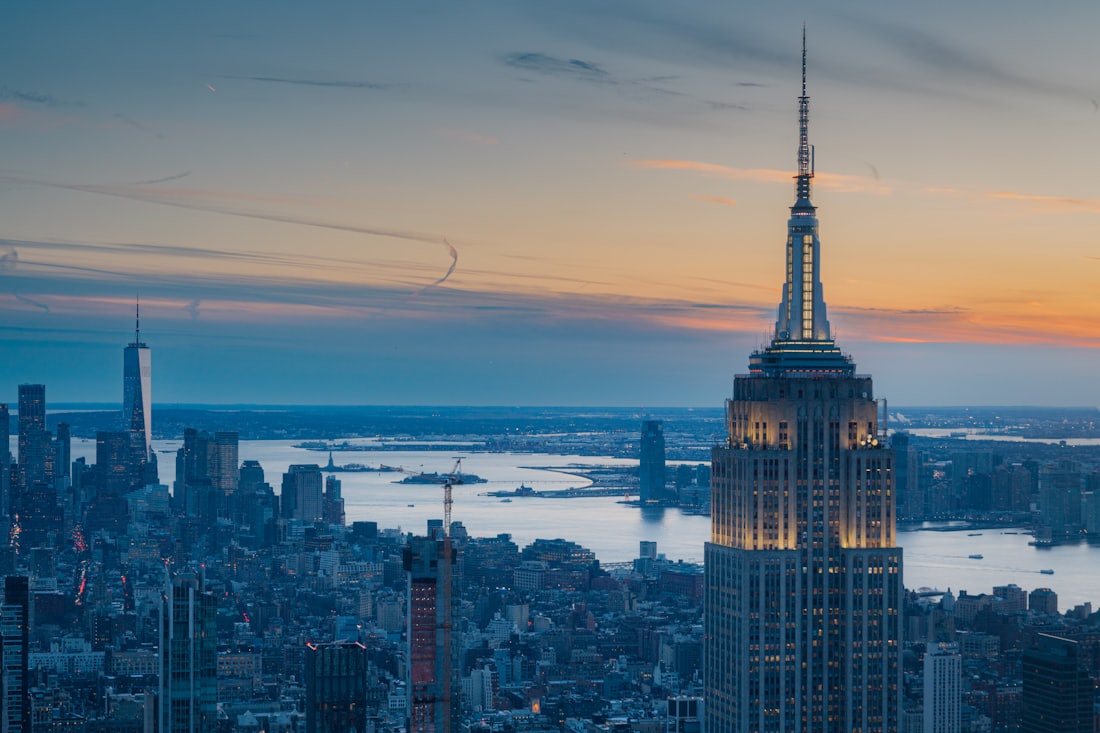
1. Which stretch blue hour is
Using the definition from golden and blue hour, blue hour is when the sun sits roughly 4 to 6 degrees below the horizon. The sun has gone but the upper atmosphere is still lit, and scattering turns the whole sky into one huge, blue light source. Light comes from everywhere, so nothing casts a hard shadow.

How long it lasts depends on latitude and date. The steeper the sun drops, the faster it crosses those two degrees. Near the equator that takes around ten minutes all year; a high-latitude summer stretches it out for ages. Today's times have to be computed for your place and date.
2. The window where things match
You are not waiting for a pretty sky. You are waiting for the moment the sky and the street lighting are about equally bright.
- Too early: the lamps are lost against a bright sky, and you have an ordinary evening snap.
- Right on time, a clear layer of blue remains, windows and streetlights are on, and both sit in the middle of the histogram together (see how to read a histogram).
- Too late, the sky is dead black with white dots on it. You're photographing lamps now.
City lights come on gradually after sunset, so early in blue hour they're often half lit. What works: be set up forty minutes early, framing and focus done, then fire the same frame every two or three minutes until the sky is gone. Pick at home; on location your eyes keep adjusting and can't judge the balance.
LCT computes sunrise, sunset and twilight for your place and date, with weather on top.
About LCT3. Setting white balance
Auto white balance sees a frame full of blue, calls it a cast, and neutralises exactly what you came for. Instead:
- Shoot RAW, so white balance can be reset losslessly later; see RAW or JPEG.
- Set a fixed Kelvin value and leave it. 3800K to 4500K is a sensible start: lower under warm sodium lamps, higher under white LED. With a fixed value the whole sequence matches and can be graded together.
- Don't chase accuracy. Cool sky and warm lamps together are what this time of day looks like. Neutralise both and the blue hour is gone; see white balance and colour temperature.
4. Long exposure or high ISO
| Goal | Starting point | Notes |
|---|---|---|
| Tripod, static city | Base ISO, f/8, 1–10s | Best quality; the gradient in the sky stays clean |
| Tripod, light trails | Base ISO, f/11, 10–30s | See long exposure |
| Hand-held street | ISO 1600–6400, wide open, 1/30–1/60s | Trading noise for mobility; see ISO and noise |
| People in frame | No slower than 1/60s | They move; a clean sky won't save a smeared subject |
Two easy things to forget. Focus while there's still light, then switch to manual and don't touch the ring again, because autofocus hunts in the dark. And turn stabilisation off on a tripod (see hand-holding and stabilisation).
5. Where starbursts come from
Starbursts come from diffraction at the edges of the aperture blades, with no filter or editing involved. Three rules:
- The smaller the aperture, the stronger the effect. They start around f/8 and are cleanest between f/11 and f/16.
- Blade count sets the number of rays. An even number of blades gives that many rays; an odd number gives twice as many, so a seven-blade aperture makes fourteen.
- You need small, bright point sources: streetlights, distant windows, a sliver of sun. An evenly lit panel won't burst.
The price is diffraction softening the frame, plus a longer exposure. Don't stop down to f/22 chasing rays. By then the whole picture is soft.
How this works in Lenscript. The LCT platform computes sunrise, golden hour, sunset and blue hour for a given place and date in local time, to within about two minutes, so you don't have to look up when to be there. The platform is still being built, and weather and air quality only get connected once it opens. For now it tells you when to leave, not whether there will be cloud.
6. FAQ
How long does blue hour last?
There's no fixed answer. It depends on latitude and date: the steeper the sun drops, the faster it crosses the 4-to-6-degree band. Near the equator it's about ten minutes all year; a high-latitude summer stretches it far longer. Work it out for your location and the day.
Why do phone night shots beat my camera straight out of the box?
Because the phone isn't taking one frame. It shoots a burst, aligns and stacks it to average the noise away, then brightens selectively. A single camera RAW needs that work done in editing. To beat the phone, put the camera on a tripod and shoot a long exposure at base ISO.
My sky came out completely black. Can I fix it?
Not really. Black areas hold no data to pull back. On the night, change the plan: make the lights the subject and keep the sky to a thin edge. Next time, get there forty minutes early.
Should I use long-exposure noise reduction?
Turn it on past about thirty seconds if hot pixels show up as isolated coloured dots. The camera shoots a matching dark frame and subtracts it, so each shot takes twice as long, which can halve your frames in a short blue-hour window. If you're racing the light, leave it off and clean up later.